Technical Deep-Dive

How we actually build AI systems.

This page is for the technical reader — covering the architecture, tool choices, and engineering decisions behind every solution we ship. No marketing fluff. Just the real stack.

The agentic stack, explained.

Every AI product we build runs on a layered architecture. Here's how the pieces fit together — from your users at the top, down to the infrastructure underneath.

LAYER 01 Interface & Input How users interact — chat UI, API calls, webhooks, or embedded widgets
React / Next.js UI REST API endpoint Webhook triggers Embedded chat widget Mobile-ready
user input → LLM context
LAYER 02 LLM Reasoning Engine Claude reasons over the request, selects tools, and manages multi-turn state
Claude Sonnet / Opus Tool use API System prompt engineering Multi-turn context Agentic loop Structured output
tool calls → execution layer
LAYER 03 Tool, Data & Integration Layer Serverless functions, data pipelines, ML models, and third-party API connectors
Vercel serverless fns Custom tool definitions Data pipelines / ETL ML model inference Analytics queries CRM / ERP connectors Third-party APIs pgvector / RAG n8n workflows
results → infra layer
LAYER 04 Infrastructure & Security Zero exposed credentials, edge deployment, env-var key management
Vercel edge network Env variable secrets API key proxy HTTPS everywhere GitHub CI/CD Zero-downtime deploys Supabase / PostgreSQL Upstash Redis

How it actually works.

Every system we ship is built on the same two-part pattern. The agent reasoning loop handles how the AI thinks. The production architecture handles everything around it — auth, data, observability, and integrations. Together they're what make an agent reliable in production, not just demo-ready.

01

The Reasoning Loop

A user query enters. Claude parses intent, plans tool calls, dispatches them in parallel, evaluates the results. If more information is needed, it iterates. When it has enough to answer, it composes a response. The loop is small. The judgment of when to call which tools — and when to stop — is where the engineering happens.
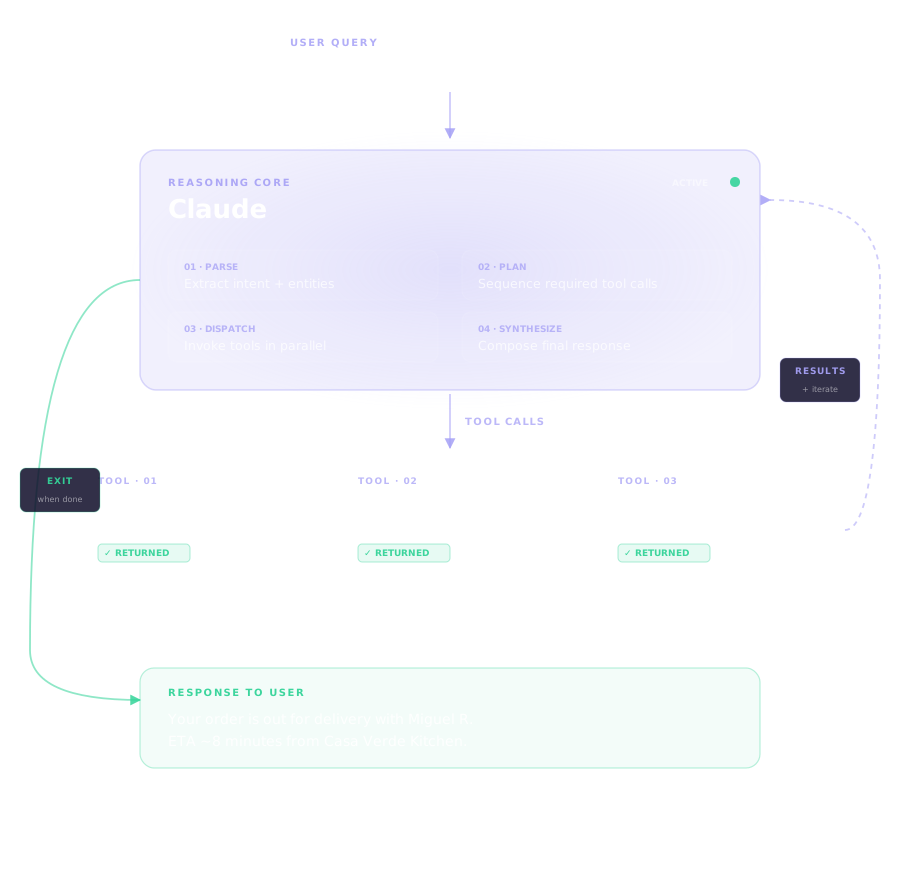
Diagram showing the agent reasoning loop: a user query enters Claude, which parses intent, plans tool calls, dispatches them in parallel, then either iterates with more tool calls or synthesizes a final response.
Reasoning + Tool Calls
Results Loop (iterate)
Exit (response ready)
02

The Production Stack

The reasoning loop is one layer of a real system. Around it sits authentication, persistence, observability, and the integrations that make it useful to your business. Same pattern across every engagement — what changes is the tool registry, the data layer, and the external services it connects to.
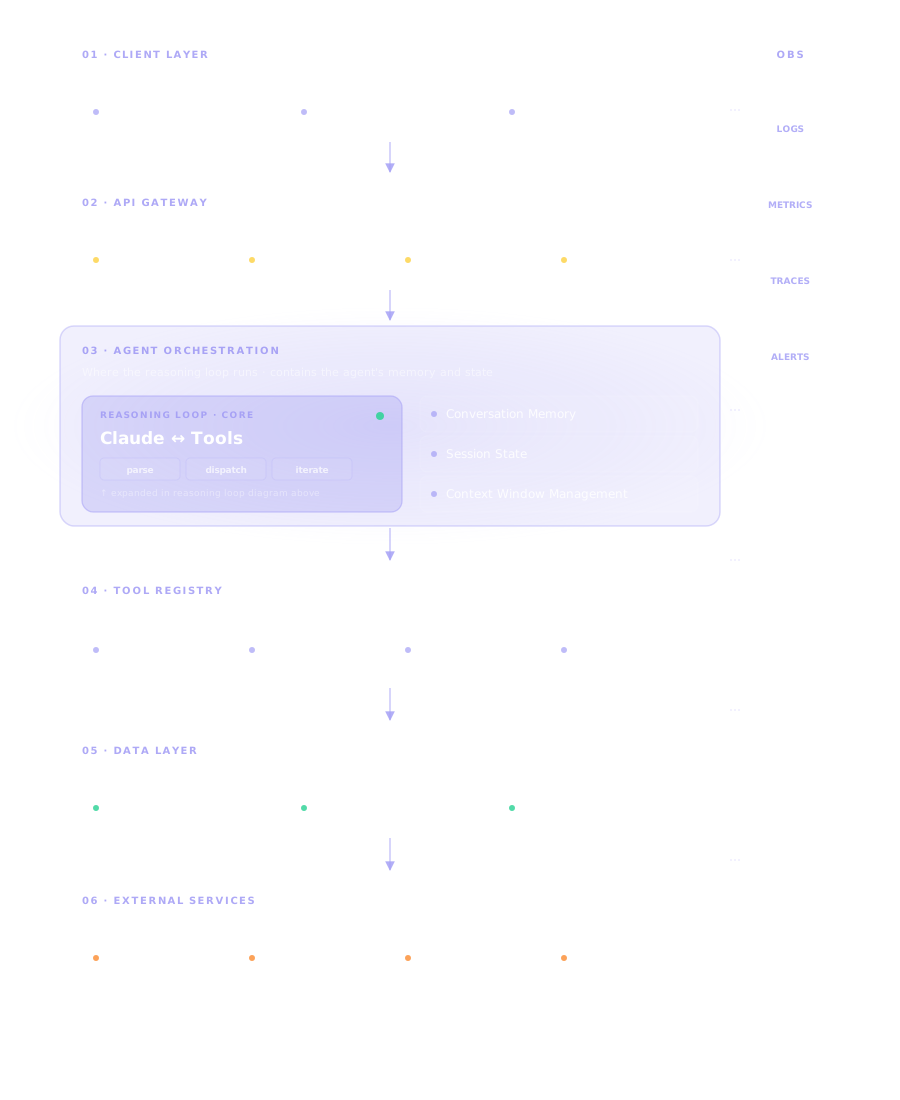
Production system architecture diagram showing six layers — client, API gateway, agent orchestration containing the reasoning loop, tool registry, data layer, and external services — with observability as a cross-cutting sidebar.
Agent + Tools
Gateway / Auth
Data Layer
External Services

What we build with.

We pick tools that are production-ready, cost-effective, and maintainable by your team — not whatever's trending on Twitter.

Frontend
React / Next.js
Language
TypeScript
Styling
Tailwind CSS
Build tool
Vite
AI model
Claude Sonnet / Opus
Agent layer
Anthropic Tool Use
Embeddings
OpenAI
RAG
pgvector
Backend
Node.js / Python
API framework
FastAPI
Functions
Vercel serverless
Workflows
n8n
Database
PostgreSQL / Supabase
Cache / queue
Upstash Redis
ETL
dbt / Airflow
Analytics
Metabase / Looker
ML libraries
pandas / scikit-learn
Data warehouse
BigQuery
Hosting
Vercel / Render
CI/CD
GitHub Actions

How we make technical decisions.

The choices we make on every build — and why we make them. These principles come from a decade of shipping production systems at scale.

01 — TOOL SELECTION
Right tool for the job, not the most impressive one
We don't reach for the most expensive model or the trendiest framework. We pick what solves the problem reliably and is maintainable by your team after handoff. Sometimes that's Claude Opus. Sometimes it's a 50-line Python script.
02 — SECURITY
Zero exposed credentials, by default
API keys never touch client-side code. Everything sensitive lives in environment variables, proxied through serverless functions. We set this up on day one — not as an afterthought before launch.
03 — HANDOFF
You own it and can maintain it
Every system ships with documentation, a walkthrough session, and a repo you can actually read. We build for the person inheriting the code, not just for the demo. No black-box vendors, no lock-in.
04 — SCOPE
Fixed scope, fixed price — no surprises
We spec the full solution before writing a line of code. You know exactly what you're getting, what it will cost, and when it ships. If scope needs to change, we talk about it — not after the invoice.
05 — RELIABILITY
Fallbacks and error handling, not fragile demos
Agentic systems fail gracefully. We build with retry logic, human escalation paths, and explicit fallback behaviors — so the system keeps working even when something goes wrong upstream.
06 — DEPLOYMENT
CI/CD from day one, not at the end
Every project has a GitHub repo, automated deploys, and a staging environment set up from the start. You see progress at real checkpoints — not a big reveal at the end of the engagement.
Ready to talk?

Got a real problem in mind?

If you've seen enough of how we build and want to explore what this could look like for your business — let's have a conversation. No deck, no pitch. Just operators talking through a real problem.